DULON

ld8-70
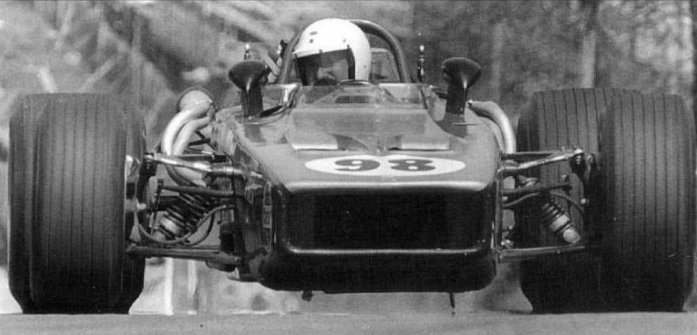
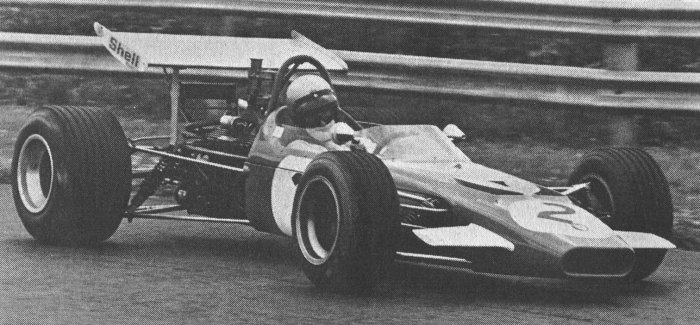
Bob Miller in the LD8 F5000 car at Brands Hatch in 1970.

DULON

Dulon Cars were built in Didcot by Andrew DUncan and Bill LONgley and they made their reputation with a number of quite successful F Ford and FF2000 cars as well as some small capacity Sports Cars. At various times some F Atlantic cars emerged as well as a rather bulky one-off F5000. In December 1967 the new F Ford LD4 was announced, it was a conventional spaceframe chassis and it was stated that a F3 version, the LD5, would be built for Cooper F3 driver Jeremy Dobson although it seems as if the car was not completed. At various other times a F3 Dulon was mooted, including a car based on the 1975 FF2000 design but they all seem to have been stillborn.

Crm

Crm

David Coode who had a handful of races in the Penny-Ford in 1964 entered the CRM at a race at Montlhéry in April 1965 but did not arrive, no engine was listed.

Drivers

1965 David Coode.

de Tomaso

de Tomaso

Alessandro de Tomaso came to Modena from his native Argentina to race Osca sports cars, when he retired he decided to settle in Modena permanently. He began constructing his own cars and in 1961 produced an F1 that would take either a 1.5 litre Osca or Alfa Romeo engine. Over the next few years de Tomaso came up with a string of various competition cars but it seemed that no sooner had a new car arrived than de Tomaso would loose interest and start on another project. All of this meant that although some of his cars were quite competitive they never received the necessary development. In 1969 they produced a reasonably competitive FVA powered F2 car and the following year Dallara was commissioned to produce an F1 car. The resultant car was run by Frank Williams and was driven by Piers Courage, things looked promising with a third place in the International Trophy at Silverstone. Tragically Courage lost his life in the car at Zandvoort and the team understandably lost heart for the rest of the year and at the end of the season de Tomaso gave up the single seater scene and concentrated on sports cars. Sadly Alessandro de Tomaso passed away in 2003.

1964

A F3 car was produced in 1964 that was basically an update of the 1962 F Junior car, fitted with a Holbay engine it showed flashes of promise including a win at Caserta.

1965

A new car was built for 1965 but results were generally disappointing, Clay Regazzoni taking a sixth at Magny Cours.

Drivers:

1964 Massimo de Antoni, Giorgio Bassi, Franco Bernabei, Giosue Butti, Mario Casoni, “Miro Gay”.

1965 Massimo de Antoni, Giorgio Bassi, Clay Regazzoni.

1966 Franco Bernabei, Roberto Bussinello, Francesco Vento.

De Nadai

de_nadai
de_nadai
de_nadai

De Nadai

The Ford powered de Nadai was raced by, and presumably constructed by, Henri de Nadai, its first appearance seems to have been at Clermont-Ferrand in July 1964 where it failed to start. There were sporadic, uncompetitive appearances until its swansong in 1967 where it finished 16th and last in Heat 1 of a race at Montjuich Park in April.

Drivers

1964 Henri de Nadai.

1965 Henri de Nadai.

1967 Henri de Nadai.

Crossle

Crossle
Crossle
watson
John Watson racing the 17F in a Formula Libre race at Mondello Park in March 1970, he finished second to a F2 Crosslé 18F.

Crossle

John Crosslé has been building cars in Holywood, near Belfast, since 1957 and is Ireland’s longest-established racing car manufacturer by some distance. The Crosslé Car Company has built cars for many formulae including F2, F3, F5000 and Sports Cars however it is in the Ford based classes that it has been the most successful. Their first car was an 1172 Ford Special produced in 1957, the first single seater was the 4F intended for use in Formula Junior or 1172cc racing. The chassis that would bring the Crosslé name to the forefront of motorsport was the Leslie Drysdale designed F Ford 16F, Gerry Birrell took the European championship in his car and over 40 cars were built and sold. Following this success Crosslé would produce large numbers of very competitive, and successful, FF1600 and FF2000 chassis.

1966

In September 1966 Gerry Corbett entered a Crosslé in a race at Castle Combe but failed to finish, it was a similar story at Brands Hatch in October. It is likely that this was a 6F, Crosslé built three of these cars in 1964, two in 1172 specification and one in F3 guise, although it seems no F3 races were undertaken. A further four models were built in 1965, three for local racing and one to American Formula C rules. The 6F was a conventional spaceframe design although the rear suspension was unusual for the time in using a combination of wishbone, transverse link and hub carrier.

1971

In 1970 Crosslé announced the 17F, a slim space framed car with conventional suspension, with drivers such as Gerry Birrell, Brian Nelson and John Watson mentioned as possible pilots but plans were shelved due to lack of development time and the car never left Ireland. Norman Moffett practised a Crosslé 17F for a non-championship race at Crystal Palace in June 1971 but withdrew before the race and he also took part in the non-championship race at Kirkistown in July. In 1973 the 26F, a derivative of the F2 22F was again announced but it didn’t seem to race, so Crosslé’s flirtation with F3 was brief and sadly unsuccessful.

Drivers

1966 Gerry Corbett.

1967 Nick Corbett, John Pringle.

1971 Norman Moffett.

6f
The 6F in 1172 spec.
nelson
Brian Nelson winning a libre race at Mondello Park in August 1970, by now the 17F had grown wings.

Crespi

Crespi

In 1987, the first year of the Sudam F3 Championship, a VW-powered Crespi scored a single point, the series that year was dominated by fellow Argentinian constructor Berta. Presumably the car was linked to the Crespi team that ran cars in a number of South American Championships notably F Renault.

Drivers

1987 Rafael Verna.

Delfin

Delfin

A home-built Czechoslovakian car that was constructed by Ing. Gajdos who worked for the Tatra Koprivnice car and truck company. The initial power plant was unusual, it was the 2472 cc V8 engine from the Tatra 603 effectively cut in half and uniquely for an F3 engine it was air-cooled, the transmission came from a Fiat 600D. Three Delfins appeared at a race in 1964 at the Sachsenring that mixed a largely East German field with 8 or so contemporary western cars. Sadly, given their very unusual components, they weren’t noticeably competitive. The next appearance (assuming it was the same car) was at a race at Brno in 1966 when two cars were entered but did not finish, one was listed as a “66” the other as a “65” indicating there were two different designs. After this a single car arrived at Hockenheim in 1968, no engine was listed so it is not certain that Tatra still provided the motive force, no result was achieved. The final appearence for a Delfin was at a race at Neubiberg in October 1969 when it failed to finish, for this race at least the motive power was courtesy of Skoda.

Thanks to Standa Cozik for additional information.

Drivers:

1964 ?
Jiri Gajdos, Alois Gbelec, Jiri Pelucha.

1966
66
Jiri Gajdos.

65
Vladimir Ondrejik.

1968 ?
Vladislav Ondrejik.

1969 ?
Karl-Adolf Kneip.

Courtois

Courtois

Frenchman Hubert Courtois raced his Courtois-Simca only once at la Châtre in June 1966 where, unsurprisingly, he failed to qualify.

Drivers

1966 Hubert Courtois.

DB

db
The DB F3 was certainly individually styled.

DB

Charles Deutsch-René Bonnet first worked together in 1939 building various Citroën based cars for smaller French races. Following the war it was 1954 before they worked together again producing a number of sports cars and single-seaters again based on Citroën running gear. The Panhard-engined DBs made their mark at Le Mans winning the Index of Performance in 1954-55-56-59-60-61 as well as taking class victories at Sebring and the Mille Miglia. In 1955 DB entered F1 with a supercharged 750cc engine fitted in a very light chassis, two cars were entered in the Pau GP but were completely outclassed.
In the early 1950s DB built a 500cc F3 car using a Panhard engine and gearbox which drove the front wheels. Front suspension was via Panhard dual transverse springs whilst at the rear two telescopic dampers acting on a solid axle. Occasionally the cars were competitive but the advent of Coopers and similar more advanced machinery soon saw the demise of the DBs. When F Junior began in 1959 the F3 cars were wheeled out again and for the first year they were reasonably competitive in French races but then history repeated itself and the Coopers and Lotuses saw the DBs vanish very quickly.
April 1964 saw the entry of a DB-Panhard at Pau, fortunately for all concerned it did not arrive.

Drivers
1964 Raymond Revard.

Cooper

T83b
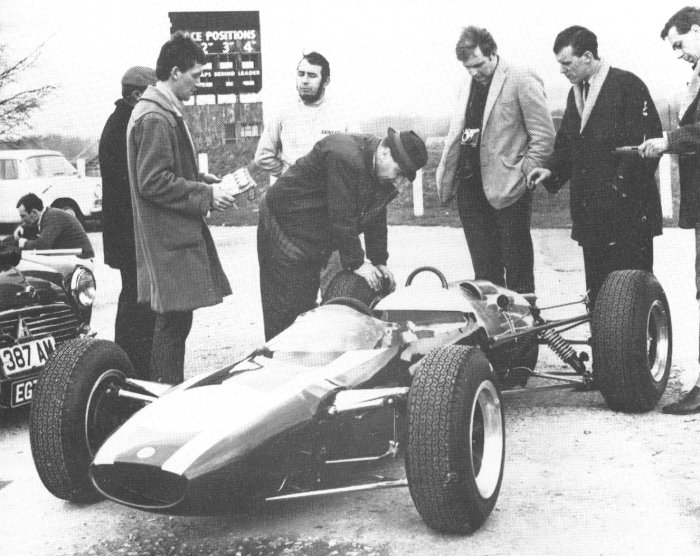
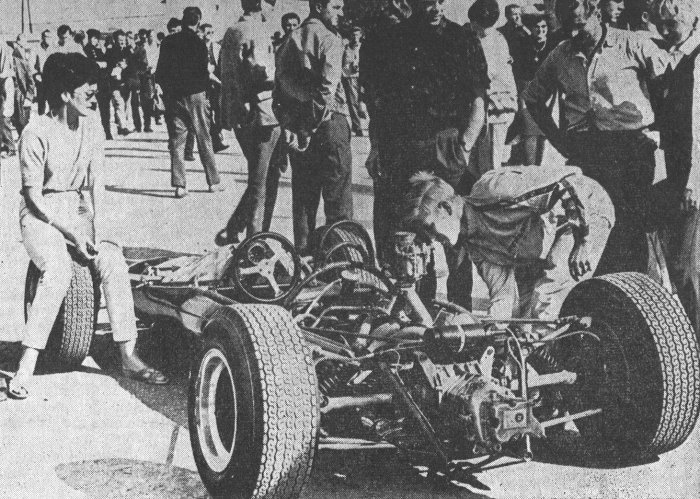
John Cooper ponders the rear suspension of a T83, driver John Fenning is behind him.

Cooper

Charles Cooper had already worked in motor sport as a mechanic and manager to Kaye Don before the war and in 1946 he built the first Coopers, two 500cc machines for his son John and Eric Brandon. The front and rear suspension of these cars used the front end of the Fiat Topolino and the power came from rear-mounted JAP speedway engines. These cars were immediately successful and a batch of customer cars were then built and raced by several up and coming stars including Stirling Moss and Peter Collins. Over the next few years the cars continued to win as yearly updates kept them at the front, in addition Cooper began to build a number of sports racers. In 1952 the 2-litre Coper-Bristol appeared and a young Mike Hawthorn soon made a name for himself with a string of wins. In 1955 a rear-engined centre-seat sports car was introduced, nicknamed the “bobtail” due to its cut off rear end. Jack Brabham put a Bristol engine in one and entered the British GP, the car was by no means disgraced and Cooper found themselves now building GP cars. Success came quickly, the little rear-engined Coopers with their Coventry Climax engines were initially considered a bit of a joke but with Stirling Moss in the Rob Walker car and Jack Brabham in the works cars they were soon being taken very seriously indeed. In the 1958 Argentinean GP Moss drove a masterful race conserving his tyres whilst the heavy Ferraris had to stop for new rubber, Moss finished the race with his tyres down to the canvas but Cooper had their first GP win. More success followed with Jack Brabham taking back to back World Championship 1n 1959 and 1960. Cooper were building cars for F1 and F2 as well as sports cars and when the new F3 started Cooper immediately began to produce customer cars, Ken Tyrrell ran the works car for newcomer Jackie Stewart who dominated the years racing. However things were not looking good for Coopers as the decade ran its course, Jack Brabham had left and he had a great influence on developing the cars, Bruce McLaren had taken his place but he would soon be leaving to start his own team. Cooper began to struggle, their F2 and F3 cars were not competitive and people stopped buying them, there was a brief revival for their F1 team in 1966 and ’67 when John Surtees and Pedro Rodriguez took a couple of GP wins but the writing was on the wall. Cooper seemed to be from an earlier era that raced for the love of competition and the new more commercialised world was not their way and in 1969 they withdrew from racing.

1964

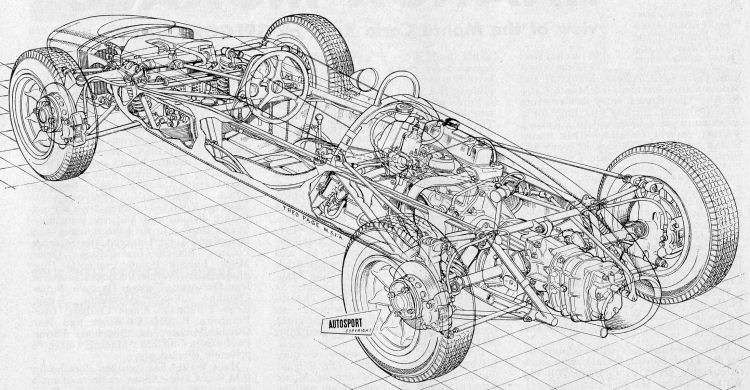
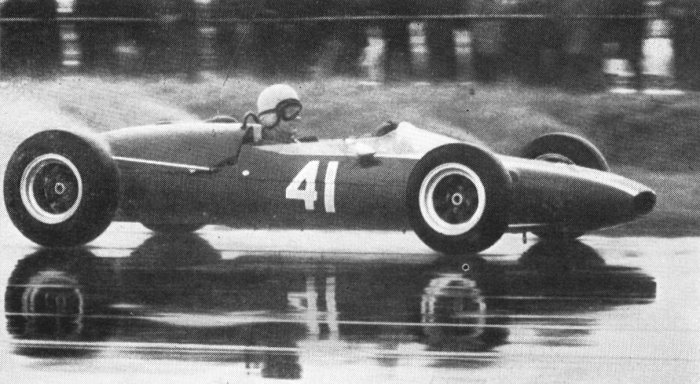
The T72 was designed by Eddie Stait and Neil Johanssen and employed a semi stressed-skin construction. This involved wrapping the 20-gauge steel floorpan around the tubular frame and spot welding it on. Front suspension was inboard with a rocker at the top and a wide based wishbone at the bottom. An anti-roll bar attached to the inboard end of the top wishbone. The main suspension pivot loads feed into the front bulkhead which had an 18-gauge steel plate welded across it. At the rear there was a light alloy top link with a lower wishbone plus an additional link behind the axle line to adjust the toe-in, a single top radius rod was also used. The uprights front and rear were magnesium castings. Brakes were Lockheed Mini-Cooper pattern front and rear. Wheels were 13 inch all round. The engine was a BMC unit derived from the Mini-Cooper ‘S’. Dimensions were 71.63mm X 61.91mm with a 12.5:1 compression ratio. A single SU HS6 carburettor with a 36mm choke plate was fitted. Power was quoted as 88bhp @ 7750 rpm. The oil cooler and radiator were combined and the oil tank sat between the radiator and the foot pedals. Unusually the lower-right frame longeron took the oil to the engine and returned via the top left longeron. The water from the radiator used the other two longerons as was common practice, the cross tube behind the drivers shoulders was the header tank, all the longerons were 16-gauge steel. The gearbox was a Jack Knight 4-speed modified Hillman Imp box fitted with interchangeable ratios. Cooper were selling the T72 for £1740 with BMC engine or £1325 without engine or gearbox. The Tyrrell dominated the season with Stewart winning 11 races and Warwick Banks one, in addition they took four 1-2 finishes. Wheelbase: 91 ins. Track: front 52 ins. rear 51 ins.
T72
Jackie Stewart testing the T72.
T72a
A stunning Theo Page cutaway of the T72.

1965

The T76 was a modified version of the T72, the front rocker-arm leverage ratio was changed to 2:1 from 1:3 to help damper life and location. The anti-squat was removed from the rear suspension and adjustable Armstrong dampers were fitted. Rearward facing radius rods were attached to the front rockers to deal with braking forces. Unsurprisingly, in view of the success of the T72, 19 T76 were ordered. Unfortunately the other manufacturers had caught up with Cooper and of course Jackie Stewart was now in F2 so there were only three victories during the year.
T76a
Warwick Banks in the works T76.
T76
A T76 sitting in the paddock.

1966

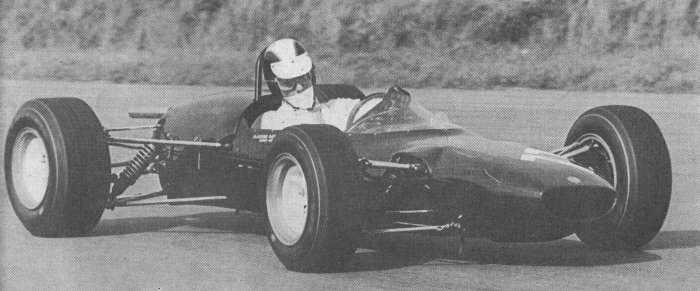
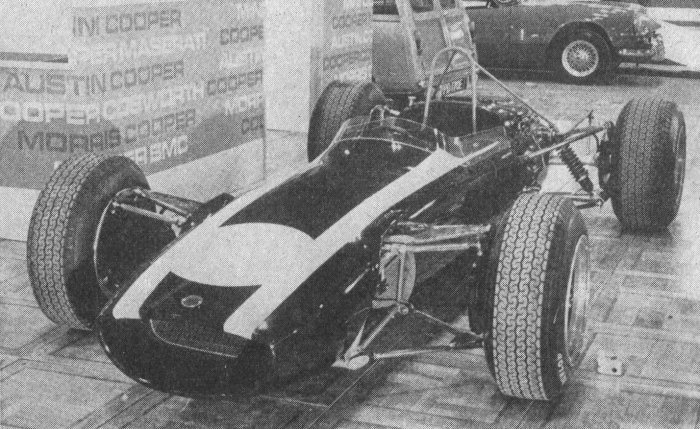
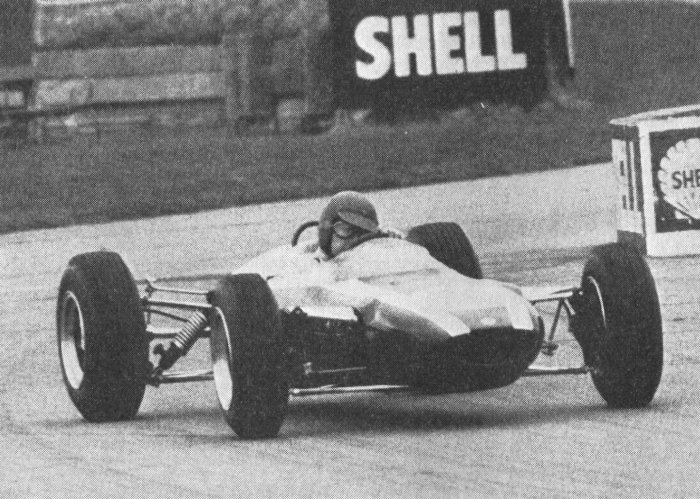
1966 saw the arrival of the disaster called the T83, once again it was an evolution of the previous car. It retained the spaceframe with semi-stressed steel stiffening, the front suspension was modified to increase the front track and decrease the leverage rate on the front dampers. The rear suspension was completely redesigned to match the geometry of the T81 F1 car and some of the components from the F1 car were also used. The other difference was a sleek new body to give a boost to the straight-line speed. Unfortunately as soon as the car reached any speed terrible amounts of understeer appeared as the front end became unstuck. Modern aerodynamic knowledge points to the new “flat bottom” design (rather than the previous “round bottom”) which was preventing trapped air from escaping. Unaware of the problem the front suspension was moved outboard in a copy of the Lotus design but since this wasn’t the problem the car wasn’t improved. Only seven cars were built and in view of the problems it isn’t surprising that results were poor.
T83
A T83 testing at Goodwood.
T83a
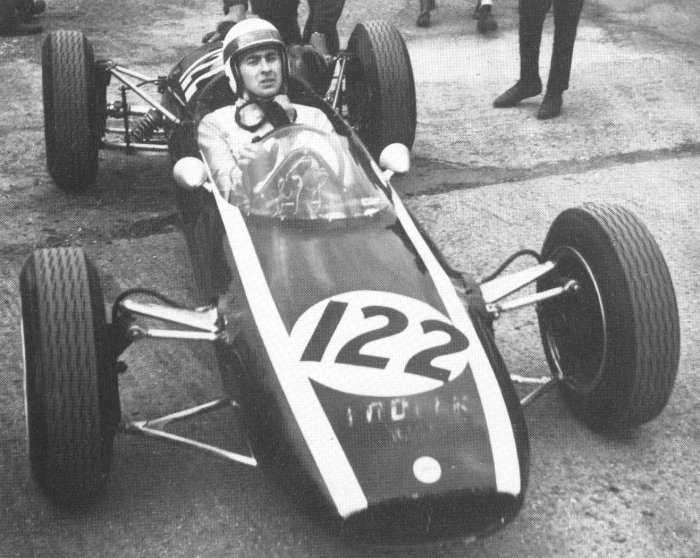
Roger Keele in his T83.

1967

Only two T85s were built after the problems of the previous year, the front suspension stayed inboard and it looked very similar to the T83. There are no details of whether the two cars raced, although a BMC-engined T85 was listed as a non-finisher at a Les Leston round at Snetterton in April 1967. It should be said that a new chassis with a BMC engine in 1967 does not seem likely. Seemingly a Ford-engined T85 ran in 1968 in a race at Montlhéry without success. One chassis was listed as a works car but does not seem to have been raced so whether the aerodynamic problems had been cured must remain a moot point.
T85
The T85 on display at the Racing Car Show.

Drivers

(N.B. Race reports in the early sixties often didn’t specify the chassis type so details are necessarily uncertain)

1964
T72
Warwick Banks, Bernhard Baur, Jacques Bernusset, Jean-Pierre Blanc, Michel Buis, Leo Cella, Michel Dagorne, Paul Deetens, Yves Deprez, Andrew Fletcher, Jean-Claude Franck, Jean-Pierre Jaussaud, John Love, Eric Offenstadt, André Periat, Peter Revson, John Rhodes, Pierre Ryser, Rob Slotemaker, Jackie Stewart, Jean Wauters.

T67
Charles Crichton-Stuart, Fritz Heini, Alain Jamar, Trevor Shatwell.

T65
Egert Haglund.

T59
Mike Budge, Hartvig Conradsen, John Greene, Otto Lux, Rolf Scheel, Günther Schramm.

T56
Michel Dourel, Theo Harzheim, Gerry Meharey, Joachim Münchow, Paul Poty.

T52
Vincenzo d’Arrigo, Karl-Adolf Kneip.

?
Bruno Deserti, Fritz Kallenberger, Guy Ligier, Harald Limberger, Richard Peel, Jacques Pouzet, Laurent Rotti.

1965
T76
Clive Baker, Warwick Banks, Rodney Banting, Jacques Bernusset,Jean Blanc, Bob Bondurant, Gunnar Carlsson, Charles Crichton-Stuart, Yves Deprez, John Fenning, Rollo Fielding, Andrew Fletcher, Mike Herbertson, Seppo Keinänen, Mike Knight, Steve Matchett, Leo Matilla, Paul Poty, Yngve Rosqvist, Pierre Ryser, Nestor Salerno, Julien Vernaeve.

T72
René Abbal, Trevor Bibb, Henning Bock, John Brindley, Michel Buis, Robert Challoy, Joseph/Georges Choukroun, Paul Deetens, Jean Denton, Gustave ‘Taf’ Gosselin, Frank Williams.

T67
Lars Bjuhr, John Kendall, Luigi Petri.

T59
Sven Andersson, Georg Duneborn, Sven-Olof Gunnarsson, Åke Lindberg, Otto Lux, Günther Schramm, “Peter Silvester”.

T52
Paul Andersen.

?
Sven Andersson, Georges Ansermoz, Clive Baker, Lars Bjuher, Jean Durif, Sven Fürstenhof, Egert Haglund, Fritz Kallenberger, Hellfried von Kiwisch, Mike Knight, Giovanni Ballico Lay, Jean-Christian Legarth, Hasse Nilsson, Ib Ödgaard, Laurent Rotti, Hardy Sandstrom, Frank Williams.

1966
T83
Clive Baker, Jean-Pierre Cassegrain, Jeremy Dobson, Hughes de Fierlandt, Keith Greene, Mike Herbertson, “Josse” (Joseph/Georges Choukron), John Kendall, Len Selby, Lars-Åke Tejby, Barrie Williams.

T76
Jean Blanc, Howard Bennett, John Brindley, Jean-Pierre Cassegrain, Eddie Coates, Barry Collerson, Jeremy Dobson, Barrie Ford, Kurt Keller, John Kendall, Tico Martini, Leo Matilla, Reine Wisell.

T72
Jean Blanc, Henning Bock, Joseph/Georges Choukron, Jeremy Dobson, James Eatherley, Alain Jamar, “Josse” (Joseph/Georges Choukron), Bob King, Hans Nilsson, John Patterson, Mike Peel, Richard Peel, Hans Sjosted.

T59
Günther Schramm.

T56
Gerry Meharey.

T52
Vincenzo d’Arrigo.

?
Svenharry Åkesson, Georges Ansermoz, Jacques Bernusset, Reiner Boczek, Heinrich Brendt, Valerio Campanati, Remigio Cianfriglia, Hans-Joachim Holze, Vladimir Kutra, J Mead, Hans Nilsson, Ib Ödgaard, Laurent Rotte, Pierre Ryser, “Peter Silvester”, Jean Sodreau, Raymond Sodreau.

1967
T85 (see “1967” above)
Mike Peel.

T83
Georges Ansermoz, Hughes de Fierlandt, Roger Keele, Ray O’Connor, Len Selby.

T76/83
Mike Herbertson.

T76
Bev Bond, Jeremy Dobson, Gunnar Elmgren, Reg Forrester-Smith, Rolf Gröndahl, René Scalais, Lars-Åke Tejby, Thorkild Thyrring, Jimmy Veitch.

T72
Jeremy Dobson, James Eatherley, Dave Rees.

T67
Ole Björn Damm, Mike Peel.

T59
Eberhard Heidler.

?
Phil Anderson, Heinrich Brendt, Bror-Erland Carlsson, Barrie Ford, Olavi Kuikka, Robert Lassus, Wolfgang Ott, Ernst Schelble, Jean-Bernard Sulpice.

1968
T85 (see “1967” above)
Ray O’Connor.

T83
“Walli”.

T76
Gaston Baillen, Roger Hansen, Rene Scalais, Lars-Åke Tejby.

T63
Josef Kremer.

?
Bror-Erland Carlsson, Roland Hedmo, Roland Löwgren, Laurent Rotti.

1969
T76
Rene Scalais.

T63
Josef Kremer.

1970
T76
Rene Scalais.

T59
Josef Kremer.

1971
?
Wolfgang Ott.
1972
?
Wolfgang Ott.