Bob King founder of Royale had his motor racing roots as a mechanic in New Zealand working on speedway machines, he later returned to the UK and went into selling road cars. One day somebody traded in an Elva sports car and Bob thought he would race it himself, this led to preparing cars for other people. To deal with all the work King set up Racing Preparations specialising in Coventry Climax engines, Alan Cornock joined the company and as the demand for Climax engines decreased the decision was made to move into constructing customer cars. In 1968 a F Ford, the Royale RP1, was produced (Royale for the Park Royal area of London and as a pun on King and RP for Racing Preparations). Over the next few years large numbers competitive F Fords and Super Vees were sold, and in 1973 Royale moved to Huntingdon however King decided to retire due to health problems in 1976 so Alan Cornock took over the company. Cornock moved the company to smaller premises and over the next few years Royale concentrated on the F Ford and Ford 2000 market with some success, Rory Byrne being their young designer. However by the 80s demand fell off and in 1984 the company went into liquidation.
1970
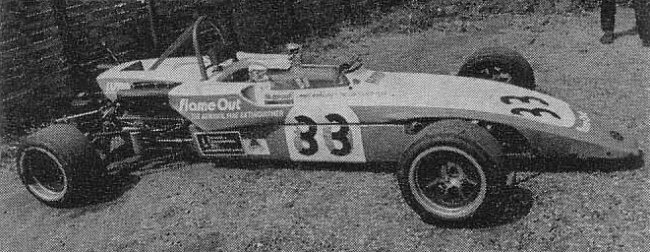
Two RP8s were constructed, the first as an Atlantic car, it used the same spaceframe chassis as the Formula Ford RP3 with the chassis extended by 2 inches. It had some success in Libre races driven by Ray Allen and Tony Lanfranchi at the end of 1970, it was then shipped to America. The second car was sold to German agent Herbert Hartge as an F3 chassis, there is no record of it ever racing in this guise.
1971
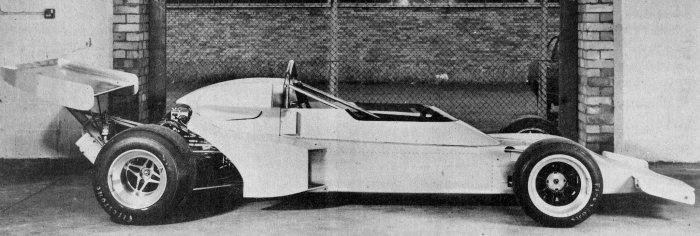
The prototype RP11, designed by Mike Smith and Peter Bohanna, was produced in late ’71 as an F3 toe in the water with no definite plans to go into production, however it was immediately competitive in Tom Pryce’s hands so the decision to sell copies was soon made. It was a monocoque design featuring a tub adapted from the RP9 Super Vee model with outboard suspension and characterised by the hip mounted radiators (a design that was also used in F Ford). Pryce would win the opening round of the 1972 British F3 championship encouraging plenty of customers for the production version.
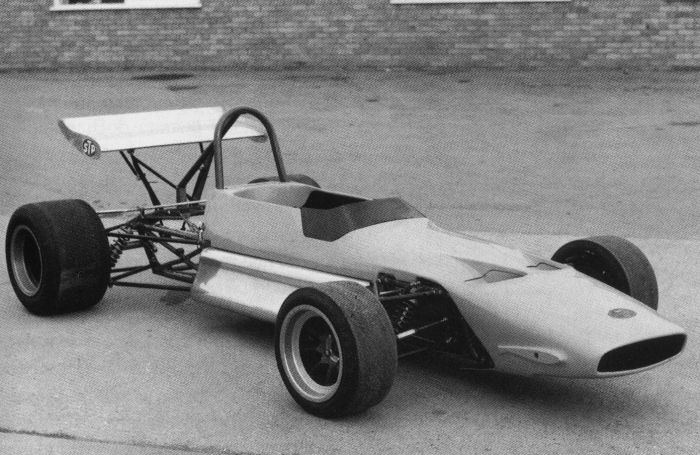
The RP8 less engine and gearbox before export to Germany.
Tom Pryce in the RP11 on its debut
at Brands Hatch.
1972
The RP11 was offered for sale in 1972 the production version differing from the 1971 prototype in having lighter magnesium wheels and uprights to reduce corner weights. 8 were built for 1972 with some models beinhg exported. Since the Royale factory weren’t set up to run a works car in F3 Pryce moved onto F Atlantic with an RP12. None of the customer drivers could get the RP11A to go as fast as Pryce could and results were disappointing.
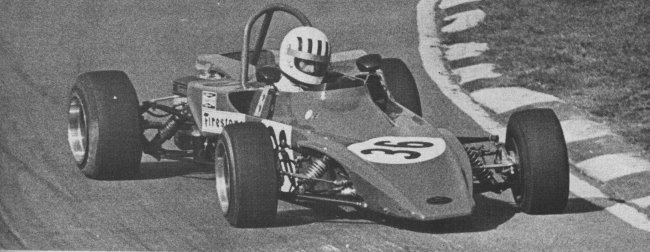
The RP11 at Oulton Park, Tom Pryce again is the driver.
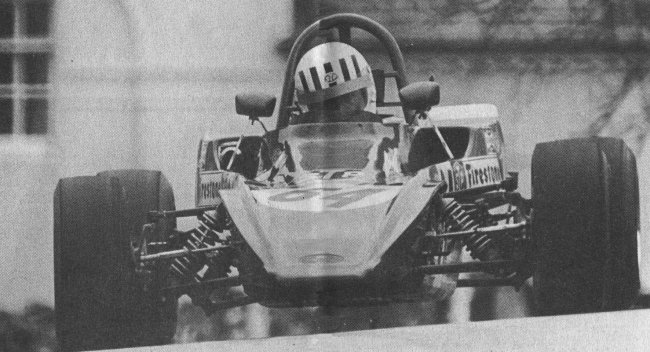
The distinctive lines of the RP11.
1973
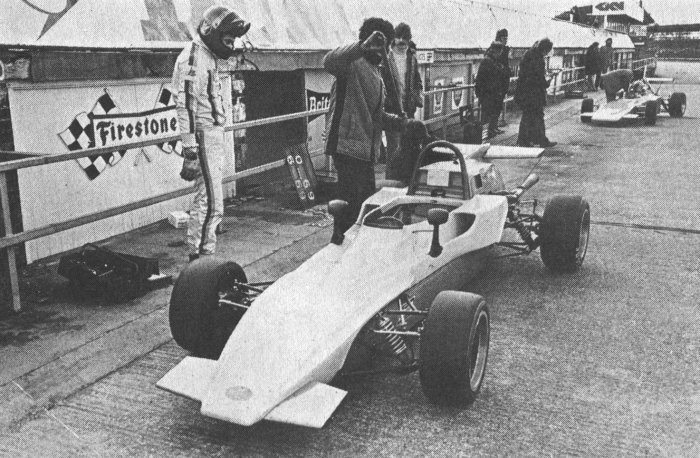
Andy Sutcliffe testing the RP11A at Silverstone.
The abortive RP20 in Atlantic trim.
A further revised version of the RP11, the RP11A was used in 1973 driven by Andy Sutcliffe, he finished 2nd (benefiting from several runners being penalised for jump starts) at Thruxton. The only real difference to the new model was the adoption of all enveloping bodywork and a wing similar to the Ensign design. Shortly after Sutcliffe fell out with the team running him and quit. This left a handful of under equipped privateers to carry the flag in RP11s. Only a single RP11A was ever built and was sold to Huub Vermeulen.
The RP20 was announced in late 1973 as a F2/F Atlantic/F3 chassis with different tubular engine bays attached to the monocoque according to the engine type. Only a single car was built and it raced once in F. Atlantic. Thus the Royale name disappeared from F3 with one exception that is, in 1978 a horrible, old and very slow RP5 (a 1970 Formula Libre design) was converted to F3 spec and did nothing to enhance the Royale name.
1977
The RP23 was designed by Rory Byrne and the initial building had begun when the whole project was sold to Roger Andreason and it became the Druid 377.
Drivers
1971 Bev Bond, Tom Pryce.
1972 Ian Ashley, Bernhard Brack, Martyn Howes, Lee Kaye, Josef Kremer, Val Musetti, Tom Pryce, Chris Pryer, Simon Sherman.
1973 Werner Jakob, Josef Kremer, Val Musetti, John Sheldon, Simon Sherman, Andy Sutcliffe, Huub Vermuelen.