|
|
| |
| Giuglielmo
Bellasi produced a number of F3 cars from 1966 to 1969, they never achieved
any great success but were one of the large number of small Italian companies
that helped boost the grids in the early years of F3.
Bellasi's greatest claim to fame was in 1970 when Swiss F1 privateer Silvio
Moser commissioned them to build him a Grand Prix car. The change in F1
regulations at that time required bag tanks which meant a monocoque so
Bellasi made a tub to receive the Ford DFV engine, Hewland gearbox and
much of the suspension from Moser's spaceframe Brabham BT24. The car managed
to qualify at the back of a couple of Grand Prix before Moser gave in.
|
| |
 |
| The first Bellasi,
as was common in Italy at the time, was based on a contemporary Brabham
chassis, driven by Giuglielmo
Bellasi himself the only result of note was a 3rd place at Lago de Garda
in May. |
| |
 |
| Bellasi switched to
a monocoque design for their 1967 car, Giuglielmo Bellasi was still the
driver, a fifth at Monza in June was his best finish. |
| |
 |
| There are no details
as to what car was used in 1968, there were no top six results recorded
in any race of note. |
| |
 |
 |
|
|
|
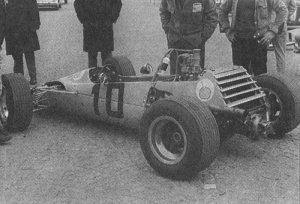
The
1969 Bellasi at Monza clearly showing the unusual front
top suspension.
|
 |
|
|
|
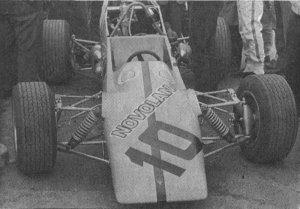
This
shot shows the pronounced wedge shape and rear mounted radiator..
|
|
A new car was introduced for 1969, it featured a fashionable wedge
shape (in fact it was nicknamed "Cuneo" meaning a wedge).
The rather spindly suspension was outboard with a very unusual looking
top wishbone and anti rollbar. The radiator really was rear mounted,
it was sited above the gearbox which presumably gave a very heavy
rearward weight bias. Once again no results were achieved despite
being driven by the experienced Giorgio Pianta and this seems to have
been the last F3 Bellasi produced. |
|
| |
|
| Drivers: |
|
| 1966 |
Giuglielmo
Bellasi. |
| |
|
| 1967 |
Alessandro
Angeleri, Giuglielmo Bellasi. |
| |
|
| 1968 |
Alessandro
Angeleri, Giuglielmo Bellasi, Franco Conti, Giuseppe Mariella, Luigi
Petri. |
| |
|
| 1969 |
Giorgio
Pianta. |
|